
Symptoms
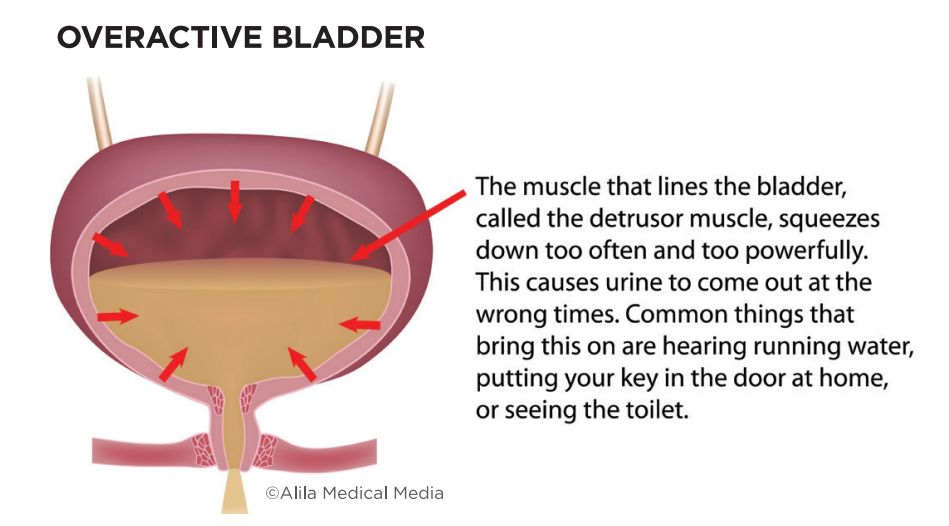
You may notice severe urgency and leakage when driving into the driveway, placing the key in the front door, running water, or with temperature changes.
This may be a sign that you have an overactive bladder (OAB). OAB is quite common, affecting roughly 15% of women. Other symptoms include:
- Frequency – peeing more than eight times in 24 hours
- Urgency – that gotta-go now sensation that is impossible to ignore
- Nocturia – waking up one or more times at night to urinate
Prevention
- Aim to pee every 2 to 4 hours rather than going “just in case”, as that can train your bladder to hold more urine comfortably.
- When the urge hits, stay still instead of rushing to the toilet. Distract yourself or take slow deep breaths and see if the urge passes before going to the bathroom.
- Track your bathroom habits. A bladder diary can help you recognize patterns and spot triggers to avoid.
Diagnosis
There are many types of health care professionals that can diagnose urinary incontinence issues. Urologists and urogynecologists can offer advanced expertise. Discuss when and how often you leak urine with your doctor.
How is OAB Diagnosed?
- Urine analysis to check for a urinary tract infection and blood in your urine.
- Ultrasound to assess how much urine remains in your bladder after urinating.
- Urodynamics to provide information on your bladder and urethra.
Treatments
Dietary Changes
Certain types of drinks can provoke bladder spasms. For example, coffee, tea, sodas and other beverages with caffeine worsen symptoms. Artificial sweeteners, fruit juices
and alcohol can also bother your bladder. Completing a bladder diary can help you look for a connection between your diet and bladder symptoms.
Bladder Training
Women with OAB tend to go to the bathroom often. However, this can make symptoms worse. Your bladder learns to hold less urine, leading to even more frequent bathroom trips. Bladder re-training involves using your pelvic floor muscles and “mind over bladder” techniques to gradually increase time between bathroom visits. As you do this more and more, your bladder muscle readjusts. This allows you to make fewer bathroom trips.
This retraining can be hard to do—ask your doctor for a referral to a pelvic floor physical therapist (PT) to learn how to do it.
Medicines
OAB medicines help your bladder hold more urine for longer periods of time. They also reduce urine leakage. Potential side effects include dry mouth and constipation. There are many different medicines available. Let your doctor know how the drugs work for you. It may take trying different medicines before you find the one that works best for you.
Pelvic Floor Physical Therapy
Most women find that pelvic floor muscle exercises help improve symptoms. For the best effect, work with a specialized PT to learn the techniques. Ask your provider for a referral. Then use these exercises every time you feel urgency. It may take 3 to 6 months of regular pelvic floor muscle exercise to see results.
Botox
Botox relaxes the bladder muscle. This allows more urine to be held in the bladder before you have to go to the bathroom. Under a local anesthetic or sedation, your provider uses a small camera and needle to inject Botox into the bladder wall.
Typically, the injection needs to be repeated 1 to 2 times a year. A small number of women experience side effects, such as difficulty emptying their bladder or urinary tract infection. Ask your provider if Botox is right for you.
Nerve Stimulation
There are many nerves involved in bladder function. Nerve stimulators help control these nerves, reducing the need to urinate often. Tibial nerve stimulation is similar to acupuncture. A small needle is inserted near a nerve in the ankle and connected to an external device that delivers small pulses to the nerve. This changes the messaging to the bladder. This is done during a series of office visits. Sacral Nerve Stimulation is a device surgically implanted near the spine. It modulates the bladder nerves.
Life With OAB
OAB is a long-term condition for many women, but it can be controlled. Most women find the right approach by combining therapies, so keep working with your provider and ask about the best combination for you. Some treatments take time. Pelvic floor muscle exercises may take 3 to 6 months of regular practice to show results, and it may take trying different medicines before you find the one that works best. Let your provider know how each treatment is working so it can be adjusted.
OAB can make you want to avoid social activities for fear of leakage, and it can feel embarrassing to talk about. You are not alone, and getting support is the first step to getting your life back.