
Botox bladder injections improve symptoms in 60-90 percent of patients for urgency urinary incontinence (UUI) and the symptoms that go along with it, like urinary frequency and urinary urgency.
About Botox
Botox is a drug made from a toxin produced by bacteria, which is called botulinum toxin.
Botox is an FDA-approved treatment. It is used medically to treat certain muscular conditions and is commonly used for other medical conditions such as chronic migraines, muscle spasms, and cosmetic procedures. You may know Botox® as a cosmetic treatment for wrinkles in the skin of the face where it is used to remove wrinkles by temporarily relaxing muscle.
Involuntary contraction of the muscle of the bladder wall, called the detrusor muscle, can lead to symptoms including urinary urgency, frequency and incontinence. Botox relaxes the bladder muscle so that your bladder can hold more urine-giving you more time to make it to the toilet without leaking.
Your medical provider may suggest Botox for UUI or overactive bladder (OAB) if other treatments, such as physical therapy and medicines, were not helpful. Certain patients should not have this treatment. You should work with your doctor on the best treatment options.
Most women find that Botox treatments slowly wear off over time. Many women find that the symptoms have returned by about 6 to 12 months. At that time, the procedure will be repeated to continue the benefits.
As with other treatments, Botox has risks. Discuss the potential risks with your doctor before the procedure, such as:
- Blood in the urine right after the procedure-small amounts are a normal, temporary side effect.
- Urinary tract infections (UTls)-fewer than 15 percent of women who have Botox treatments need treatment for UTls.
- Difficulty emptying the bladder (called “urinary retention”)-women who experience this, need to catheterize themselves or wear a catheter temporarily. This happens less than 6 percent of the time and is not permanent.
- Allergic reactions to Botox, such as trouble breathing, vision problems, and generalized weakness.
Make sure you have all your questions answered ahead of time and know how to contact your doctor with questions or problems after the procedure.
How the Procedure is Done
Botox injections are usually performed in a doctor’s office. You do not need general anesthesia or an overnight hospital stay. You can eat and drink normally on the day of the procedure. The actual procedure takes about 10 minutes. However, the entire visit may require one hour.
When you arrive, you’ll need to give a urine sample. This sample will be checked for signs of UTI. If you have a UTI, the procedure will need to be rescheduled. If you have symptoms of a UTI at home, call the office right away.
Similar to undergoing a pelvic exam, you’ll undress from the waist down. You’ll lie on the exam table with your feet in stirrups and cover yourself with a sheet. After cleaning your genital area with an antiseptic solution, a numbing gel may be inserted into the urethra prior to the procedure. You may also be given an antibiotic to take by mouth.
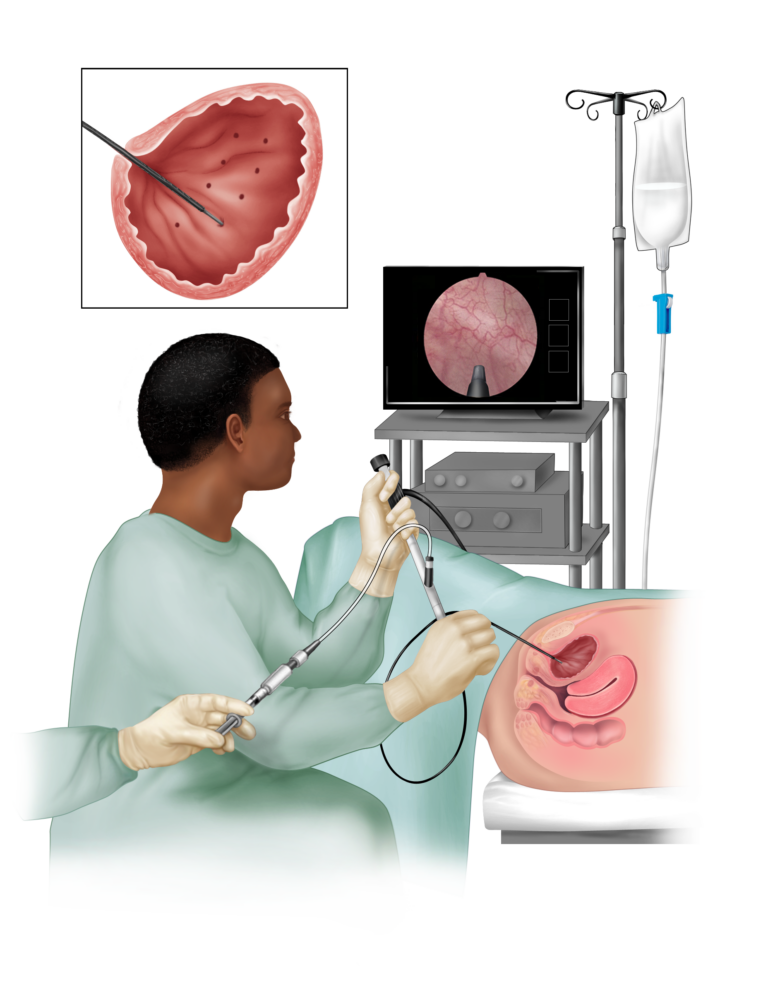
Next, the doctor will use a cystoscope, or lighted camera, to visualize the inside of your bladder. A thin needle will be used to inject very small amounts of a Botox solution into your bladder muscle. Some women experience discomfort but most find it tolerable.
Before you go home, you’ll be asked to urinate. Sometimes the injections cause difficulty emptying the bladder. If this happens, you may need to use a catheter. Your doctor’s assistant will teach you how to catheterize yourself, or to care for a catheter that remains in place until it is removed.
After the Procedure
Most women can resume their normal activities immediately after the procedure. You can drive yourself home after the procedure, although some women prefer to ask someone to drive them. You could also return to work if needed. Ask your doctor if you should continue any bladder medicines you are taking before the procedure.
Botox does not work immediately. It can take several days to two weeks until you experience relief from that sudden “gotta go now” feeling. Most women report reduced episodes of UUI. Most women find that their bladders are able to hold more urine. Thus, they do not have to urinate as often.
For the first few days after the injection you may feel the need to urinate more frequently. You may notice stinging or burning when you urinate and blood in your urine. Your doctor may prescribe or recommend an over-the-counter medicine to relieve the burning. This medicine may change the color of your urine. A warm bath or putting a warm or cool, damp washcloth over your genital area may help to relieve.
Call your doctor’s office if you experience any of the following symptoms:
- Trouble urinating or a sense that the bladder isn’t emptying.
- Heavy bleeding, including bright red colored urine or large clots in the urine.
- Burning with urination, changes to the color or smell of urine, or chills and fever (greater than 101 degrees Fahrenheit).
- Trouble breathing, confusion, disorientation, or agitation.
As the Botox wears off over several months, most women experience a gradual return of their urinary symptoms. Contact your doctor’s office and schedule a follow-up appointment.
Three Takeaways
- Botox is an effective treatment for urgency urinary incontinence and overactive bladder.
- Botox injections are usually performed at a doctor’s office. You do not need general anesthesia or a hospital stay. You can usually drive yourself and can return to work immediately after the procedure. Most people do not find these injections painful.
- Some women find long-term relief of urgency urinary incontinence and overactive bladder symptoms with a single injection. Others find that Botox treatments wear off after 6 to 12 months. At that time, the procedure will be repeated to continue the benefits.
Learn the Terms
Onabotulinum toxin A (Botox): A drug made by extracting a protein from the botulinum bacteria. Botox causes muscles to relax. It can be used to treat bladder and other muscle disorders, as well as to remove facial wrinkles.
Urgency urinary incontinence (UUI): Urinary leakage that occurs with the sudden, strong desire to pass urine.
Overactive bladder (OAB): Urinary urgency, usually with frequency and nocturia, and sometimes with urgency urinary incontinence. This occurs without an infection or other health problem.
Urinary tract infection (UTI): The abnormal growth of bacteria in the urinary tract combined with symptoms like urgency and frequency of urination. The urine may also be cloudy, bloody or have a foul odor.
Catheter: Plastic tube temporarily placed to drain urine from your bladder.
Urethra: Tube from the bladder to the outside of the body that urine passes through during urination.
Cystoscope: A thin tube with a small telescopic camera on the end used to visualize the inside of the bladder. There are two types of cystoscopes: Flexible and rigid. A cystoscopy is a procedure using a camera (cystoscope) to look at the inside of the urethra and bladder.